

PER9 Sport Watch Face Mesa
PERSONA Watch Face
PER9 Sport Watch Face Mesa is the kind of Wear OS personalization app I would choose when I want my watch to look more like a compact sports instrument than a miniature phone. It comes from PERSONA Watch Face, is free, and is suitable for Everyone. I found its appeal less in decoration and more in the way a digital layout can make a quick glance feel purposeful: time first, supporting information around it, and a visual style that fits an active routine.
The central idea is simple: this is a digital watch face with a sporty identity. That sounds modest, but it changes how the watch feels during the day. Instead of opening an app to check the time and then searching for the information I need, I can treat the watch face itself as the starting point. For someone who prefers a clear, functional wrist display, that is the real reason to try it.
Why the digital layout matters more than the decoration
The strongest capability here is the watch face’s role as a permanent glance surface. A traditional watch face mainly answers one question: what time is it? A sport-oriented digital design suggests a different habit. I look down while walking, commuting, exercising, or moving between tasks, and I expect the display to feel immediately readable rather than ornamental.
That makes the choice personal. If I want a soft, classic appearance or a highly decorative design, Mesa is probably not the first option I would install. Its value comes from a more practical attitude. The screen is meant to feel like part of an active setup, so the visual language suits people who enjoy a modern, structured watch rather than a simulated analog dial.
In my experience, this kind of design works best when I stop treating the watch face as wallpaper. The useful question is not whether it looks impressive in a store preview, but whether I can understand it during a two-second glance. A busy face can be attractive and still be frustrating when I am outside, carrying something, or trying not to interrupt a conversation. Mesa makes more sense for users who prioritize that quick interaction.
Related News

Why WhatsApp Messenger Still Makes Everyday Communication Feel Easy

Jurassic World: The Game Is the Better Dino Tycoon for Strategic Players

Threads in Real Life: Who Should Join, Lurk, or Leave

How SHEIN Turned Shopping Into an Endless Content Feed

How to Make Fortnite Feel Smarter on Mobile

Should You Switch to Microsoft Outlook on Mobile?
The practical advantage is glance efficiency: I can check the wrist without turning the moment into a phone-checking session. That small difference matters during a commute, a short walk, or a workout warm-up. It also helps me keep the phone in my pocket when all I need is a quick time check.
What I would look for before installing it
I would begin with the question of visual fit. The store identifies it as a PER9 Sport Watch Face, and that description sets a useful expectation: the design belongs with casual clothing, trainers, outdoor routines, and people who like digital sports styling. It may feel out of place if my goal is a formal watch appearance for every occasion.
I would also consider the size and shape of my Wear OS display. A layout that feels balanced on one watch can feel cramped on another, especially if the screen is smaller or has a different bezel shape. This is not a fault unique to Mesa; it is a normal trade-off with watch faces. Still, it is worth checking the preview on the actual watch rather than deciding from a phone screenshot alone.
Gallery
The app has been available since March 13, 2022, which gives it a little context. It is not presented as a brand-new experiment, and its presence in the personalization category has allowed it to build a visible user base. The current average is 4.3 from around 2.4 thousand ratings, while the listing shows more than a hundred written reviews. I read those numbers as a sign of steady interest, not as a guarantee that every Wear OS user will love the same visual choices.
How the watch face fits into a normal day
My favorite use case is a day when I am moving between several small activities. In the morning, I can glance at the wrist while preparing breakfast instead of picking up the phone. On the way out, the same face keeps the watch feeling like a simple instrument. Later, during a walk, I can check the time without unlocking another screen or getting distracted by notifications.
That workflow sounds ordinary, but it reveals an important difference between a watch face and a separate utility app. A utility app requires an action. A watch face is already present. The benefit depends on whether the design presents information comfortably enough that I do not need to tap around. For me, this is where a sport-oriented digital face earns its place.
I would not install Mesa expecting it to transform the watch into a complete training platform. The app’s confirmed identity is a Wear OS watch face, not a replacement for dedicated exercise software. If I need detailed workout analysis, route planning, or a full health dashboard, I would use the relevant watch or phone tools instead. Mesa’s job is to give the wrist a useful visual starting point, not to become the entire fitness system.
There is also a subtle battery-related trade-off in choosing any watch face. A more information-heavy or constantly active display can demand more from the watch than a very simple face, depending on the device and its settings. I would therefore test it through a normal day rather than judging it after a short setup session. If battery life is my top concern, I would compare it with an extremely minimal face and keep the one that fits my routine better.
A realistic scenario: keeping the phone away during a walk
Imagine I am walking to a local shop after work. I want to know the time, but I do not want to pull out the phone because that usually leads to checking messages and losing the rhythm of the walk. With Mesa on the watch, the face becomes a low-friction checkpoint. I raise my wrist, read the digital display, and continue.
The same pattern works when I am waiting for a bus, carrying groceries, or standing in a queue. These are not dramatic situations, but they are exactly where a watch face proves its usefulness. The best design is the one that removes a tiny interruption repeatedly throughout the day. A sporty digital appearance reinforces that quick, functional behavior.
For exercise, I would use it before and after an activity as well as during short pauses. It can make the watch feel more appropriate for training clothes and outdoor movement, even when I am not actively recording a workout. That distinction matters: the face supports the mood and convenience of an active routine, while the actual exercise tracking remains a separate responsibility.
A less obvious use is travel. When I am navigating an unfamiliar day, I often need frequent time checks rather than constant phone interaction. A digital face helps me make those checks quickly. I would still use the phone for tickets, maps, and messages, but the watch can handle the small time-related moments without becoming another source of distraction.
Where Mesa is stronger than the usual alternatives
The usual alternatives fall into two broad groups. One group uses analog styling to imitate a conventional wristwatch. The other group uses highly customizable digital layouts that can be adjusted until almost every available space has a purpose. Mesa sits closer to the sporty digital side, so its advantage is immediate identity rather than endless configuration.
Compared with an analog face, a digital sport design can feel faster to read when I am in motion. I do not need to interpret hand positions, and the overall presentation is more consistent with a technical or athletic outfit. Compared with an extremely customizable face, the appeal is restraint. I can choose a clearly defined look instead of spending time building one from separate elements.
That simplicity is useful for people who want a finished design. Many customization apps are powerful but can turn setup into a project. I have spent enough time adjusting watch layouts to know that flexibility is not always the same as convenience. A focused design can be the better choice when I want to install something, wear it, and stop thinking about configuration.
There is a trade-off, of course. Users who enjoy changing colors, rearranging every field, or matching the face precisely to different outfits may prefer a more open-ended alternative. Mesa makes the most sense when its existing visual direction already matches my taste. If it does not, no amount of appreciation for the concept will make the daily experience feel right.
Small workflow tips that improve the experience
First, I would install it when I have time to view the face in several lighting conditions. A screen that seems excellent indoors may feel different outdoors, especially under bright sunlight. I would check it while standing, walking, and holding the wrist at a natural angle. That gives me a better idea of whether the digital information is genuinely easy to read.
Second, I would avoid evaluating it only while the watch is perfectly centered in front of me. Real use is messier. I usually glance from the side, with the arm partly lowered, or while carrying something. A face that remains understandable in those moments is more valuable than one that looks perfect in a staged screenshot.
Third, I would give myself a short adjustment period. Changing a familiar watch face affects muscle memory. At first, I may look for information in the wrong place simply because I am used to another design. After wearing Mesa through a full routine, I can decide whether the layout feels natural or whether I am constantly searching for the detail I want.
Finally, I would keep a backup face available. That is not because Mesa is unreliable; it is because different situations call for different visual priorities. A sporty face may be ideal for errands and exercise, while a quieter design may suit a formal meeting. Switching between them is more practical than demanding that one face work perfectly for every part of life.
The limitations I noticed in the concept
The biggest limitation is the same feature that gives Mesa its character: the sport-focused presentation. It will not satisfy everyone. If I prefer a warm, traditional, jewelry-like, or highly personalized appearance, the design may feel too technical. Personalization is subjective, and a strong visual identity can be a benefit for one user and a barrier for another.
Another limitation is that a watch face cannot solve every information problem. Even a well-organized digital display has limited space. When I need deeper context, I still have to open a watch app or use the phone. I would not choose this app on the assumption that a glance face can replace detailed widgets, health tools, or notifications management.
There is also the question of long-term novelty. A striking sports design can feel fresh at first, but I might eventually want a calmer face for variety. That does not make Mesa a poor choice; it simply means I would treat it as a strong style option rather than a permanent answer for every mood and outfit.
Because it is free, the cost barrier is low. That makes experimenting sensible, especially if I already own a compatible Wear OS watch. Still, free does not remove the time cost of testing, adjusting, and deciding whether the face remains comfortable after several days. I would judge it by repeated glances, not by the installation moment.
Who will get the most from it
Mesa is best for someone who wants a digital watch face with a clear sports personality and who values quick wrist checks. It suits an active daily routine, casual clothing, and users who would rather start with a coherent design than build a face from many individual controls.
It is also a good trial for someone moving away from an analog face. The digital format can feel more direct, especially if I often check the time while walking or exercising. Since the app is free and carries an Everyone age rating, there is little reason not to test it when the style matches what I want from the watch.
I would be more cautious if I require extensive customization, a formal appearance, or a face designed around detailed health metrics. In those cases, a different personalization option may be a better fit. I would also skip it if I dislike sporty visual language in general; no practical argument can compensate for looking at a watch face I do not enjoy wearing.
The developer, PERSONA Watch Face, has positioned this release clearly within Wear OS personalization rather than trying to make it something else. That focus is helpful. The listing shows over a hundred thousand installs, so it is not an obscure experiment, but popularity should remain secondary to the actual match between its design and my habits.
My final take after using the face
I see PER9 Sport Watch Face Mesa as a focused choice rather than an all-purpose recommendation. Its strength is the relationship between a sporty digital look and fast, everyday time checks. When I want my watch to feel active, modern, and ready for movement, that relationship works well.
I would recommend trying it to a friend who wants a free Wear OS personalization app and prefers a finished sports design over a long customization session. I would explain that the real test is not the first impression; it is whether the face remains readable and comfortable during ordinary, imperfect glances. If it does, Mesa can quietly improve the way the watch fits into the day.
My honest conclusion is that this is a worthwhile option for the right wearer, not a universal replacement for every watch face. Its 4.3 average and growing audience suggest that the approach connects with many users, while the focused styling still demands a personal taste check. I would install it, wear it through a normal routine, compare it with my current face, and keep it if the quick digital glance feels more natural than the alternative.
FAQs for PER9 Sport Watch Face Mesa
What is PER9 Sport Watch Face Mesa?
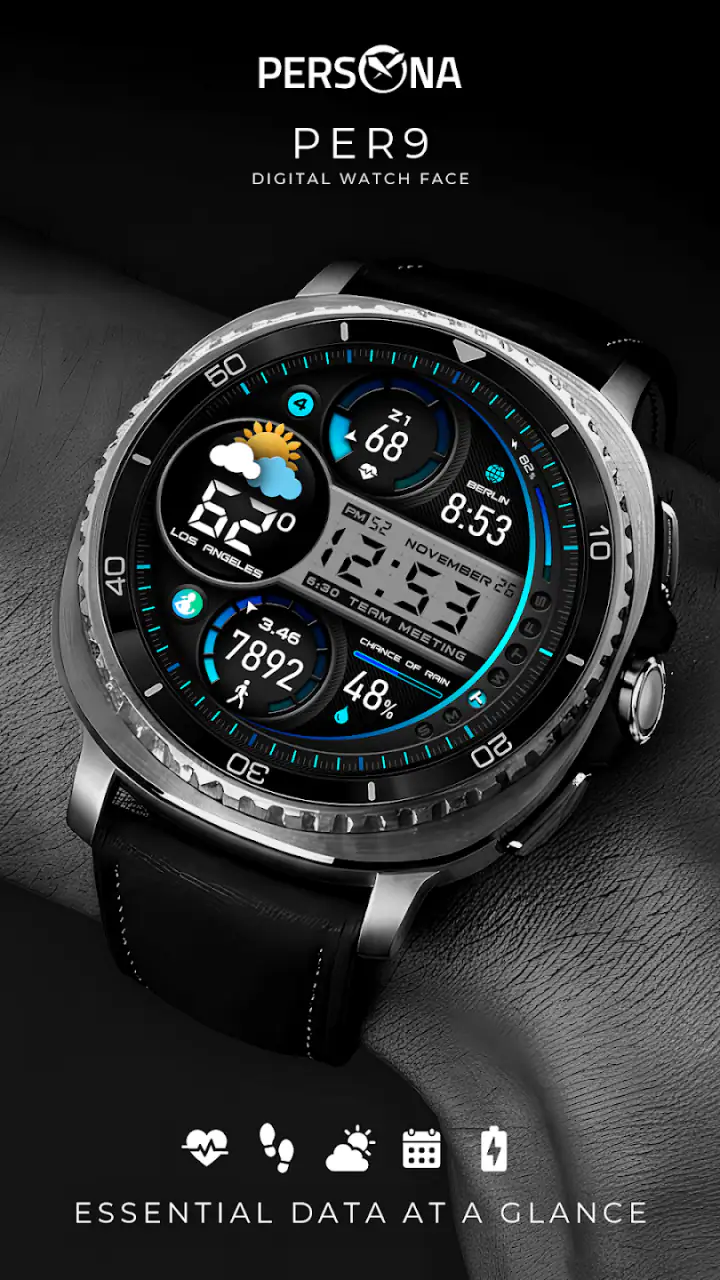
PER9 Sport Watch Face Mesa is a sporty Wear OS watch face designed for users who want quick access to time, date, and fitness-related information from their smartwatch. Its layout focuses on a modern, athletic appearance with clearly separated data areas. Before downloading, check that your watch uses a compatible Wear OS version, since it is intended for smartwatches rather than Android phones or iPhones.
Which smartwatches are compatible with PER9 Sport Watch Face Mesa?
Compatibility depends mainly on your smartwatch operating system and the version supported by the developer. PER9 Sport Watch Face Mesa is designed for Wear OS devices, but not every older Android-based watch will support it. Samsung Galaxy Watch models using Wear OS, Google Pixel Watch devices, and other compatible Wear OS watches may work. Always review the Google Play listing for the latest supported-device information before installing.
What information can I see on this watch face?
The watch face is built to display essential information without requiring you to open another app. Depending on the selected configuration and your smartwatch capabilities, you may see the current time, date, battery level, and fitness or activity data such as steps, heart rate, or other complications. Some details can depend on Wear OS permissions, connected sensors, and the complications available on your particular watch.
Can I customize PER9 Sport Watch Face Mesa?
PER9 Sport Watch Face Mesa may offer customization through the Wear OS watch-face editor, allowing you to adjust available colors, complications, or displayed information. The exact options can vary according to the version installed and the watch model being used. After installation, press and hold the current watch face or open the watch-face settings to check which design and data fields can be changed.
Does PER9 Sport Watch Face Mesa affect battery life?
Like any active smartwatch face, PER9 Sport Watch Face Mesa can have some effect on battery consumption, particularly when it uses animated elements, frequent updates, always-on display mode, or health sensors. The actual impact varies by watch, brightness, screen technology, and enabled complications. If battery life becomes a concern, reduce always-on usage, limit live data fields, and disable complications you do not regularly need.
Pros
- Clean
- sporty design that suits workouts and everyday wear.
- Clear time display remains easy to read at a quick glance.
- Useful fitness-focused data is visible directly on the watch face.
- Compact layout avoids unnecessary visual clutter.
- Works well for users who prefer a modern digital watch style.
Cons
- Some displayed data may require a compatible Wear OS watch.
- Customization options can be limited compared with premium watch faces.
- Small complications may be difficult to read on smaller screens.
- Battery impact can vary depending on refresh rate and active data fields.
- The sporty appearance may not suit formal or classic watch styles.


